Xudong Mechanical Manufacturing

Professional manufacturer of spirals; one-stop customized service for non-standard machinery.
MORE +
Xudong Mechanical Manufacturing

Professional manufacturer of spirals; one-stop customized service for non-standard machinery.
MORE +
Xudong Mechanical Manufacturing

Ensure product processes meet international standards
MORE +
scroll down
视频标题

ABOUTXUDONG

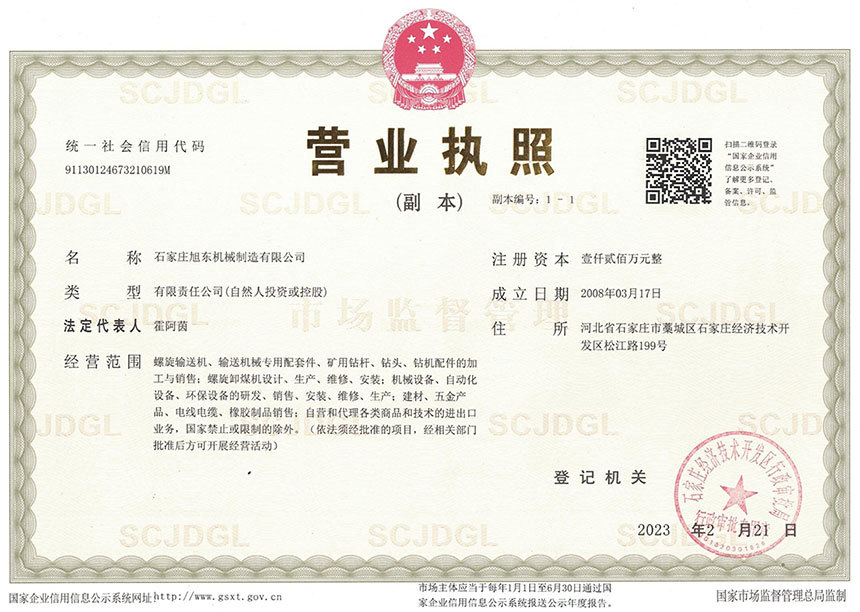
Shijiazhuang Xudong Mechanical Manufacturing Co., Ltd.


Shijiazhuang Xudong Machinery Manufacturing Co., Ltd. was founded in 2001 and is located in Shijiazhuang Economic and Technological Development Zone. The company has a 20,000-square-meter production workshop and a 4,000-square-meter comprehensive R&D and office building. We are committed to providing one-stop services including R&D, design, production, manufacturing, installation and commissioning for screw conveying equipment and powder material handling solutions across various industries.
Our core products cover screw blades, screw auger shafts, separation drums, various welded shafts, mixing shafts, screw conveying equipment and customized non-standard equipment. They are widely used in agricultural machinery, construction machinery, food machinery, chemical machinery, pharmaceutical machinery, environmental protection machinery and other industries. Our products have won wide recognition in the market for their excellent design, ease of use and convenient maintenance.
From raw material selection to finished product delivery, all processes comply with the dual certification standards of ISO9001 and ISO3834. With more than 20 years of technical accumulation, our products are exported to more than 40 countries and regions around the world.

Step into Xudong
2001

The product is exported to more than 40 countries and regions.

24000 ㎡

Factory area exceeds 24,000 square meters

94

10 professional design technicians, including 4 senior engineers

40 +

The product is exported to more than 40 countries and regions.

Our strengths

A manufacturing enterprise integrating spiral machinery product design and manufacturing, installation and commissioning, and technical consulting—all delivered as a one-stop service.

A trustworthy and pragmatic corporate culture

For the past 20 years, we’ve steadily pioneered with a corporate philosophy that embodies warmth, passion, resilience, resonance, professionalism, and unwavering ambition—paving the way to build a century-old industry leader in the spiral machinery sector.

Advantage

Professional and Technical Team

Our company has 10 professional design and technical personnel, including 4 senior engineers, and 80 skilled frontline employees.

Advantage

Advanced production equipment

We are equipped with advanced machinery, including large laser cutting machines, massive plasma gantry cutters, and a variety of CNC lathes, enabling us to boost production capacity while maintaining superior quality.

Advantage

Rigorous quality control

We have a robust quality control system and professional product-testing equipment, ensuring that the products you receive are beautifully crafted and reliably high-quality.

Advantage

Partners


Partners
Partners
Partners
Partners
Partners
Partners
Partners
Partners
Partners
Partners
Partners
Partners
Partners
Partners
Partners
Partners
Application Scenarios

Widely praised across various industries

The company’s products are primarily used in the production of components for industries such as agricultural and livestock machinery, environmental protection equipment, construction machinery, mining and metallurgical equipment, chemical processing machinery, and food machinery, as well as in automated logistics, coating systems, and custom non-standard mechanical solutions.

  • Agricultural Machinery Industry:The core components of equipment such as combine harvesters and corn shellers are responsible for horizontally conveying grains along with impurities, using horizontal and vertical auger modules to efficiently fill silos while minimizing the need for manual intervention.
  • Chemical and Building Materials Industry:For the enclosed transportation of powdered and granular chemical raw materials (such as plastic pellets, coating powders) and building materials (cement, sand, and gravel), preventing moisture or contamination of the materials, and compatible with equipment like reactors and mixers.
  • Food processing industry:Designed for the precise metering and conveying of ingredients like flour and powdered sugar, its low-resistance design minimizes material breakage. At the same time, the dual helix system—rotating in opposite directions—ensures uniform mixing of viscous materials such as dough and sauces.

Agricultural Machinery Industry

Grain processing industry

Chemical and Building Materials Industry

Environmental Protection and the Waste Recycling Industry

Food processing industry

Agricultural and Forestry Machinery

Metallurgy and Mining Industry

Automated Logistics

OURBLOGS

Company News and Industry Updates

Aug 12,2026

A Guide to the Standard Conveyor Angle Range for Screw Conveyors

The tilt installation angle of a screw conveyor directly affects its conveying capacity, equipment failure rate, and overall service life. Different designs—whether with or without a shaft, U‑shaped or tubular—and materials with varying physical properties require significantly different standard tilt angles. In many production lines, improper tilt‑angle design leads to persistent issues such as material backflow, blockages, blade deformation, and motor overload. This paper systematically reviews the standard conveying‑angle ranges for all types of screw conveyors, along with material‑compatibility guidelines and optimized solutions for steep inclines, providing a standardized reference for equipment procurement and on‑site retrofitting.

Aug 11,2026

Solutions for Spiral Blade Warping and Deformation | Dual Options: Custom-Made New Parts + Repair of Used Components

In powder and solid-waste conveying lines for mining, food‑waste processing, fine chemicals, grain and feed production, and other industries, spiral blades frequently suffer from twisting, warping, and sagging—leading to common equipment failures. Deformed blades can cause machine vibration and abnormal noises, material backflow and blockages, and overloading that damages gearboxes, significantly increasing downtime and the cost of spare‑part replacements. Drawing on years of experience in the R&D and manufacturing of spiral blades, we have systematically identified all the root causes of blade deformation and introduced two comprehensive solutions: a custom‑designed anti‑deformation system for new equipment and a corrective‑repair service for existing blades, effectively resolving the persistent issue of repeated twisting and premature scrapping.

Aug 10,2026

Customized wear-resistant auger solutions for conveying highly abrasive materials

When conveying highly abrasive materials such as mineral slag, sand and gravel, cement powder, food‑processing waste, and hard lithium‑battery powders, the screw conveyor’s flight blades and drive shaft are continuously subjected to material erosion and impact, making them prone to rapid thinning, perforation, and fracture. Frequent replacement of components and downtime for maintenance can significantly increase a company’s overall operating costs. Leveraging years of experience in the custom manufacturing of screw‑conveyor parts and complete systems, we offer four comprehensive wear‑resistant solutions tailored to severe abrasion conditions: material upgrades, surface hardening, structural optimization, and integrated protective measures. We can either design and manufacture brand‑new wear‑resistant screws or retrofit existing older units with wear‑resistant enhancements, effectively extending equipment service life and minimizing downtime‑related losses.

Aug 08,2026

Eliminate blade shedding and fracture! Eradicate defects such as cold solder joints and poor welds, and employ heavy‑duty welding processes to resolve the issue of equipment downtime in mining operations.

Spiral auger blades suffer from false welds, rough weld beads, and insufficient penetration. When used over the long term to convey highly abrasive materials such as sand, gravel, and ore, they are prone to cracking, weld failure, and complete blade detachment or fracture, often resulting in unplanned production line shutdowns for maintenance. This paper analyzes the hazards associated with common welding defects in the industry and details our plant’s rigorous standards—full-penetration Class I welding combined with nondestructive testing—providing a comprehensive solution to the persistent problem of blade‑related downtime.

Aug 06,2026

Say goodbye to frequent bearing replacements! Dynamic imbalance in helical augers causes vibration, noise, and cracking of the base—here’s a definitive solution.

Bearing replacement every 3–6 months, severe high-speed vibration, excessive noise, and repeated cracking of the base are common problems plaguing most standard screw augers. The root cause lies not in bearing quality but in the failure to perform proper dynamic balancing and calibration. This article details the hazards and underlying causes of these industry‑wide issues, as well as our factory’s comprehensive solution: a two‑stage dynamic balancing and correction process.

Jul 31,2026

2025–2031 Global and China Screw Conveyor Industry Report Analysis

Industry Research Network has released the “Global and China Screw Conveyor Market: Current Status and Development Trend Analysis Report (2025–2031),” which covers domestic and international customs import‑export statistics, global regional procurement preferences, and the competitive landscape among domestic and overseas manufacturers. The report also provides a comprehensive breakdown of raw material price cycles for carbon steel, 304 stainless steel, and 316L stainless steel augers, offering authoritative data to support overseas trade strategies, pricing decisions, and regional market promotion.

Jul 24,2026

Spiral Auger Conveyor: Inheriting 2,300 Years of Ancient Wisdom, a Core Piece of Modern Industrial Equipment

Originating from Archimedes’ screw in the 3rd century BCE, this device has undergone a comprehensive evolution. We offer heavy-duty, custom-designed screw conveyors suitable for a wide range of industries, including food processing, agriculture, chemical manufacturing, environmental protection, and mining. After 2,300 years of continuous refinement and iteration, it remains an indispensable core piece of equipment in the field of bulk material handling.

Jul 17,2026

Guide to Distinguishing Between Tubular Shafted, U‑Shaped Shafted, and U‑Shaped Shaftless Screw Conveyors

This article distinguishes among three types of screw conveyors—tubular with shaft, U‑shaped with shaft, and U‑shaped without shaft—providing a quick method for identifying the model based on its housing and internal structure, and comparing their respective advantages and disadvantages. It also clarifies the materials each type is best suited to handle and the industries in which they are most applicable: tubular conveyors are ideal for dry powders and granules; U‑shaped conveyors with shafts are appropriate for sand, gravel, and ores; and U‑shaped conveyors without shafts are specifically designed for handling sludge, food waste, and other materials prone to entanglement. A selection guide is included to help users customize conveying equipment according to their needs and avoid common issues such as material blockages and winding.

Jun 30,2026

U‑shaped shaftless screw conveyor: Should lining plates be installed or not?

When selecting screw conveyor equipment, whether to equip a U‑type shaftless screw conveyor with or without liners is a critical issue that many purchasers and equipment managers tend to overlook.

Jun 25,2026

The complete installation and commissioning process for scraper conveyors, addressing issues such as misalignment, chain jamming, and chain skipping.

This paper provides a detailed overview of the entire standardized installation and commissioning process for scraper conveyors, specifying assembly‑accuracy requirements for the foundation, frame, chain, and drive unit. It also establishes clear acceptance criteria for no‑load and loaded trial runs and offers key preventive measures to address common malfunctions such as misalignment, chain jamming, and pin‑shaft detachment, serving as a practical reference for construction and operations personnel.

Jun 24,2026

Code for Installation and Construction of Bucket Elevators with Chain Drive

This paper presents the complete installation procedure for a bucket‑type chain conveyor, specifying precision standards for key operations such as foundation verification, casing assembly, drive alignment, and chain‑bucket installation. It also outlines measures to control casing and sprocket misalignment errors in accordance with equipment height. Upon completion, the equipment undergoes two‑stage commissioning and acceptance—no‑load and loaded tests—with quantifiable acceptance criteria for temperature rise, vibration, conveying capacity, and other parameters. These practices standardize the construction process and help minimize operational failures.

Jun 23,2026

Does the auger need dynamic balancing?

Many users ask: Why is it necessary to balance a screw conveyor? In fact, the fundamental purpose of dynamic balancing is to ensure that the equipment operates more stably, safely, and durably.

Jun 22,2026

Cement Screw Conveyor: Do You Really Know It Inside and Out?

With its robust structure, environmentally friendly sealing, resistance to blockages, durability, and convenient installation—along with its versatility—this cement screw conveyor has become the standard conveying equipment in industries such as concrete, cement, dry-mix mortar, and building materials.

Aug 31,2024

The Relationship Between Double-Blade Augers and Single-Blade Augers

Theoretically, if the pitch is the same, a twin-blade screw conveyor and a single-blade screw conveyor should deliver material at the same rate—and at the same rotational speed. After all, the amount of material discharged per revolution is directly tied to both the pitch and the speed. In practice, however, there are differences in leakage due to clearance gaps. The twin-blade screw conveyor experiences less material loss, resulting in slightly more consistent output. Additionally, while the single-screw conveyor discharges material once per full rotation, the twin-screw conveyor delivers material twice per rotation—each time dispensing half the amount compared to the single-screw model. This design effectively addresses the issue of uneven material distribution.

Aug 31,2024

When processing spiral blades, be sure to pay attention to electrical safety.

Electricity is like a tiger—once it bites, it won’t let go. No matter what we’re doing, we must take proper precautions to prevent electric shocks. 1. Switches must be insulated and their installation should be secure. After finishing work, always check whether the power switch is turned off. 2. Before opening any electrical cabinet, make sure the power supply is completely isolated from the equipment. The main power source for the device must be switched off, and a clear "Do Not Enter—Unauthorized Personnel Only" sign should be posted on the equipment.

Aug 31,2024

Regarding the use of sludge dewatering machines

The screw-type sludge dewatering machine, a commonly used piece of equipment in the wastewater treatment field, has gained widespread adoption due to its efficient and reliable performance. To ensure the equipment fully leverages its advantages, it is particularly important to thoroughly understand the operating procedures and key precautions before use.

Jul 28,2022

The Structural Principles and Application Scope of the Screw Auger Conveyor

The main body of the screw conveyor consists of three sections: the head section, the intermediate section, and the tail section. Typically, during final assembly at the factory, the intermediate sections are arranged in order of length—starting with the longest one placed closest to the head section, while intermediate sections of equal length are positioned next to each other. Inside the head section, a thrust bearing is installed to handle axial forces, while the intermediate and tail sections house support bearings that hold the helical shaft in place. Additionally, the tail section includes a radially adjustable bearing capable of axial movement, designed to compensate for any inaccuracies in the helical shaft’s length and accommodate thermal expansion or contraction. The helical flights come in two types: solid (S-type) and belt-type (D-type). The individual helical shafts are connected using flanged joints, ensuring interchangeability of the connecting shafts and simplifying maintenance.

Jan 10,2022

Do you really understand the spiral conveyor?

The screw conveyor, whether judged by its name or its compact physical structure, often gives users the mistaken impression that it may look impressive but isn’t very practical. However, this couldn’t be further from the truth—it’s a device that uses the rotation of a helical shaft to efficiently convey materials, capable of handling both horizontal and inclined movements. Let’s now take a closer look at its structure and unique features!

Nov 12,2021

Mining machinery, biomass power plant, cantilever shaft, helical shaft with helix

The properties of biomass also cause severe wear on the blades at the head of the screw feeder. After a period of operation, the circumference of these blades tends to decrease, significantly reducing the material-handling efficiency. This often leads to uneven feeding, material bridging, and even blockages—issues that can disrupt the stable operation of the boiler. Based on the wear cycle, it’s recommended to replace the screw feeder blades annually, or alternatively, to repair them every six months by patching, rebuilding the wear-resistant layer through re-welding, and reinforcing the root welds. This proactive maintenance helps prevent blade tilting, cracking, or detachment due to inadequate upkeep.

Nov 12,2021

The cutterhead auger of the harvester comes in two materials: iron and aluminum.

The iron cutterhead auger is a traditional option. It’s sturdy, durable, and affordable, capable of handling heavier loads and higher operational intensity. At the same time, iron augers exhibit excellent wear resistance even in harsher environments, making them still a popular choice for certain specialized harvesting tasks. However, the iron cutterhead auger also has some notable drawbacks, such as its heavy weight and susceptibility to rust—issues that require extra care during use.

Nov 12,2021

The material of the screw conveyor shaft can vary widely, depending on the specific application requirements and environmental conditions. Here are some common materials for screw conveyor shafts along with their key features:

Stainless Steel: One of the commonly used materials for auger shafts is stainless steel, particularly grades 304 and 316. These materials offer excellent corrosion resistance and wear resistance, making them ideal for applications in food processing, pharmaceuticals, and other industries—while also meeting stringent hygiene and safety standards. PEEK Material: PEEK is a specialized engineering plastic known for its high rigidity, strength, and hardness, as well as outstanding chemical resistance and superior performance under high-temperature conditions. Auger shafts made from PEEK are perfectly suited for environments that demand exceptional resistance to both corrosion and abrasion.

Nov 09,2021

How to Choose Materials for Chemical Mixer Agitators and Stirring Shafts

The properties of the agitation medium—such as viscosity, density, corrosiveness, and temperature—directly influence the selection of materials for both the agitator and the agitator shaft. The shape and size of the agitator also play a crucial role: different agitator designs are suited to specific types of media, requiring careful material selection based on the intended agitator configuration. Finally, the operating conditions of the mixer—including factors like rotational speed, power requirements, and duration of operation—can significantly impact the choice of materials for both the agitator and the shaft.

Nov 09,2021

How to Choose a Blender's Blender Blade

When selecting a mixer impeller, several factors need to be considered, including the properties of the material, the purpose of mixing, the geometric dimensions of the equipment, the motor’s power, the impeller’s capacity and geometry, rotational speed and power output, material composition, as well as maintenance and cleaning requirements. Material properties: Different materials have varying characteristics such as viscosity, density, and solubility, requiring the selection of an appropriate impeller to meet the specific mixing needs. For instance, for high-viscosity materials, an impeller with strong mixing capability and higher rotational speed—such as a propeller-type impeller—is typically recommended.

Professional manufacturer of the Spiral series products

If you're interested in our products and services, please don’t hesitate to reach out—Xudong looks forward to collaborating with you for mutual success!

Contact us